
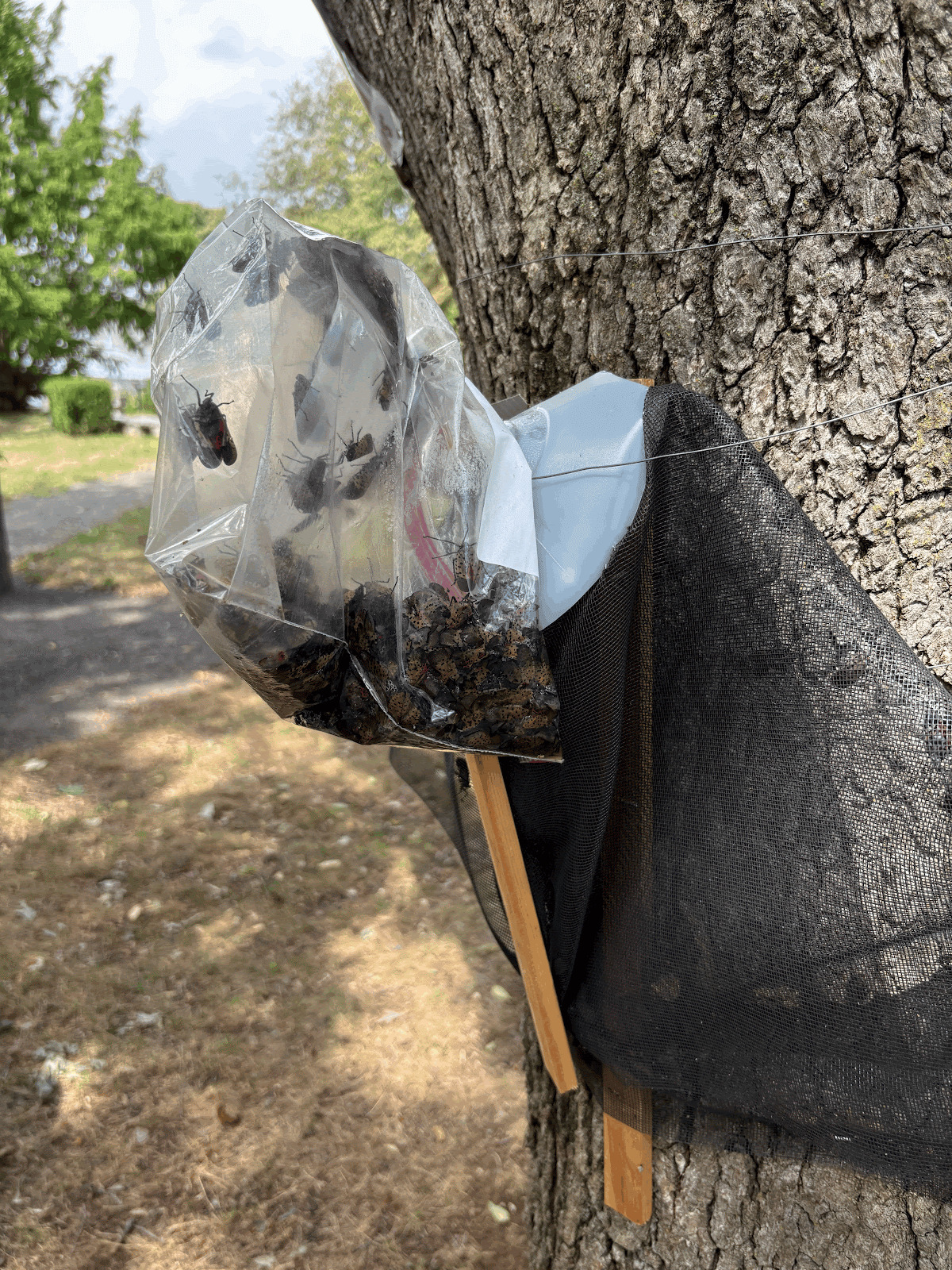
It neither bites nor stings, yet somehow the spotted lanternfly has become one of the most harmful insects in our country’s history. What makes this small bug so dangerous isn’t its threat to humans, but rather, the damage it causes to the environment when left unchecked. Since its arrival in the United States, this species has spread rapidly across several states. They have become a major agricultural concern due to their widespread damage to surrounding vegetation.
The spotted lanternfly originated in China, but didn’t emerge as a problem until it was transported to other areas outside its native lands. According to the Natural History Museum, it was first believed to have been spotted in countries such as Korea and Japan as far back as the 1930s. However, the first confirmed sightings in those countries took place in 2006 and 2008, respectively, where it consequently became invasive. From there, the species remained fairly unnoticed until around 2014, when it was allegedly shipped over on a rock or wood shipment, leading to its eventual sighting in Berks County, Pennsylvania. Since then, its population has exploded across the East Coast and into the Midwest, with high numbers reaching from North Carolina up to Massachusetts, turning into the massive infestation we’re dealing with today. To put it in perspective, a 2021 survey even found around 61,000 lanternflies in Pennsylvania alone.
As the spotted lanternfly population spread beyond Pennsylvania, the real problem began to emerge, which is that they face virtually no predators in the U.S., allowing their numbers to grow unchecked. As an invasive species, this past decade is the first time that many animals have encountered them. For that reason, no creatures have started eating them on a large enough scale, allowing the population to spiral out of control.
Consequently, their natural feeding process, normally manageable in their natural ecosystem, has become extremely destructive. These insects feed by sucking sap from plants such as grapevines and fruit trees (in total, around 70 different species). As they eat, they excrete a substance called honeydew onto the plant, which according to the U.S. National Park Service, “promotes sooty mold growth, which blocks sunlight from reaching leaves, inhibiting photosynthesis.” This eventually kills the plant. This process, combined with their large numbers and wide distribution, has caused major damage to crops and thus losses for agricultural industries. Overall, the Pennsylvania Department of Agriculture estimated a devastating $324 million loss due to lanternfly activity in 2019.
The key to stopping the spread can partially be found through understanding the lanternflies’ developmental tendencies. Spotted lanternflies undergo something called incomplete metamorphosis, meaning they have three main stages in their lives, including an egg stage, nymph stage, and then an adult stage. This differs from complete metamorphosis (what butterflies go through), which includes a pupa phase. Each stage has specific techniques you can use to deal with this species.
One of the most effective ways to decrease their population is by watching for egg masses on the trees in the winter. Lanternflies typically lay eggs in October, which then hatch in the late spring. According to Cornell Integrated Pest Management, egg masses have a muddy color to them. They camouflage onto tree bark, so make sure to look carefully. If you happen to find some, use a card such as a credit card or ID to scrape the masses into a plastic bag. From there, seal the bag and either freeze or crush it to ensure that none escape.
If you miss the egg phase, no worries! After hatching, they enter the nymph stage which consists of four developmental stages called instars. These occur from approximately June through August. Early-stage nymphs are quite tiny, with black bodies covered in white spotting all over, and most noticeably a lack of their iconic wings. Through the first three instars they mainly grow larger, and by the fourth they turn their distinctive red. Throughout all three instars, you may see the nymphs climbing up trees and other vertical structures. This is because lanternflies have an instinct to climb upwards. The Penn State Circle Trap design is one solution for this stage that takes complete advantage of this tendency. With netting, wire, a milk carton, and a plastic bag, you can easily make it yourself! According to their instructions, it involves cutting the top of the milk carton into a funnel, fastening netting into the top piece, placing a plastic bag around the wider opening, and tying it to the tree with the plastic bag side up. This way, the lanternflies climbing up the tree become surrounded by the netting and continue climbing through the funnel into the plastic bag. This type of trap is beneficial because when attached to the popular trees, it can attract so many lanternflies, reducing damage to plants and trees around it. Additionally, once the plastic bag is full, you simply take it off, seal it, and replace it with a fresh one. However, with the circle trap, there is the possibility of accidentally trapping other innocent bugs, a phenomenon called bycatch.
If the infestation has already progressed past these stages, there are still actions you can take to combat them. Once the nymph phase finishes, usually around early September, they make their transition to their adult stage. Adult lanternflies grow grey wings and stay active into the fall, laying egg masses in tree bark from September to October before dying off in the winter. Adult lanternflies can still be caught with the circle traps, however, there are other solutions that are more direct.
One option is to mix a solution made of dish soap and water. Spraying it on the lanternflies can inhibit their ability to jump, which is arguably the hardest thing about squashing them, and can be used to remove them from hard-to-reach areas. However, if sprayed directly onto the greenery, it can cause the plants to dry up if considering sunlight, so it’s only recommended for open areas.
No matter what stage, you should also look out for a plant called the tree of heaven, another invasive species as well as the spotted lanternfly’s host plant! Lanternflies thrive from it, and according to an article from Michigan State University, “adult females produce many more eggs when they feed on ToH compared with other tree species.” The tree of heaven has many thin stems growing from a base. If you find one, carefully dig it out, making sure to fully remove it from the root. However, take care not to confuse it for another plant called sumac, which looks similar but has serrated leaves, in contrast to the tree of heaven’s smooth ones. Simply by removing this plant, you can significantly reduce local lanternfly populations.
Finally, you can let nature assist. People have begun to observe animals like birds, bats, and even frogs to be picking up these pests every once in a while. An article from the National Audubon Society even describes how in 2021, an iNaturalist page had “78 observations of 33 different species chowing down (on spotted lanternflies).” Encouraging these animals will help with long-term control, but it will take years before it can become large-scale. Of course, the easiest thing to do is to step on them whenever you see one!
While spotted lanternflies are certainly beautiful insects, what they do to plants and ecosystems is not so pretty. It’s important that we all work together to get this infestation under control. Just remember, if you see ‘em, squash ‘em.
Harrison, T., Crick, J., & McCullough, D. (2023, October 2). A Tale of Two Invaders: Tree of Heaven and Spotted Lanternfly. Integrated Pest Management. https://www.canr.msu.edu/resources/a-tale-of-two-invaders-tree-of-heaven-and-spotted-lanternfly
Osterloff, E. (2021, October 15). What’s so bad about the spotted lanternfly? Www.nhm.ac.uk. https://www.nhm.ac.uk/discover/whats-so-bad-about-the-spotted-lanternfly.html
Spotted Lanternfly Biology and Lifecycle. (2018). CALS. https://cals.cornell.edu/integrated-pest-management/outreach-education/whats-bugging-you/spotted-lanternfly/spotted-lanternfly-biology-and-lifecycle
Spotted lanternfly. Commonwealth of Pennsylvania. (n.d.). https://www.pa.gov/agencies/pda/plants-land-water/spotted-lanternfly#:~:text=It’s%20not%20just%20our%20plants,and%20more%20than%202%2C800%20jobs.
Spotted Lanternfly in Perspective (U.S. National Park Service). (2021, February 18). Www.nps.gov. https://www.nps.gov/articles/000/slf-in-perpective.htm
Swackhamer, E., Korman, A., Leach, H., & Francese, J. (2024, February 16). How to Build a Spotted Lanternfly Circle Trap. Extension.psu.edu. https://extension.psu.edu/how-to-build-a-spotted-lanternfly-circle-trap